For a long time, the conversation about AI in the workplace has been shaped by big organizations. Enterprise rollouts. Company-wide platforms. Massive training budgets. When you read about AI adoption, it's usually a story about a company with hundreds of employees, an IT department, and a Chief Technology Officer making strategic decisions about infrastructure.
If you run a small non-profit, manage a team of twelve at a municipal office, or operate a small business with no dedicated tech staff, that conversation can feel like it has nothing to do with you. The tools sound expensive. The implementation sounds complicated. And the assumption baked into most of the advice is that you have people whose job it is to figure this out for you.
That assumption is wrong. And it's costing small organizations more than they realize.
The real cost of "we're too small for that"
Small organizations don't have the luxury of inefficiency, but they live with it every day. The intake process that runs on email and spreadsheets. The reporting that takes a full day because the data lives in four different places. The hiring that happens through shared documents and sticky notes passed between panel members. The client tracking that depends on one person's memory and a filing system only they understand.
These aren't technology problems. They're workflow problems that have always had technology solutions, but those solutions were just out of reach because building them required a developer, a budget, and a timeline that small organizations couldn't justify.
Small organizations have been priced out of the tools they needed most. That's no longer the case.
What's actually changed
The shift isn't that AI has gotten smarter. It's that building functional tools has gotten dramatically simpler. Things that used to require a software team can now be built by the person who understands the problem, using plain language and an AI tool.
This isn't theoretical. Here's what that looks like in practice:
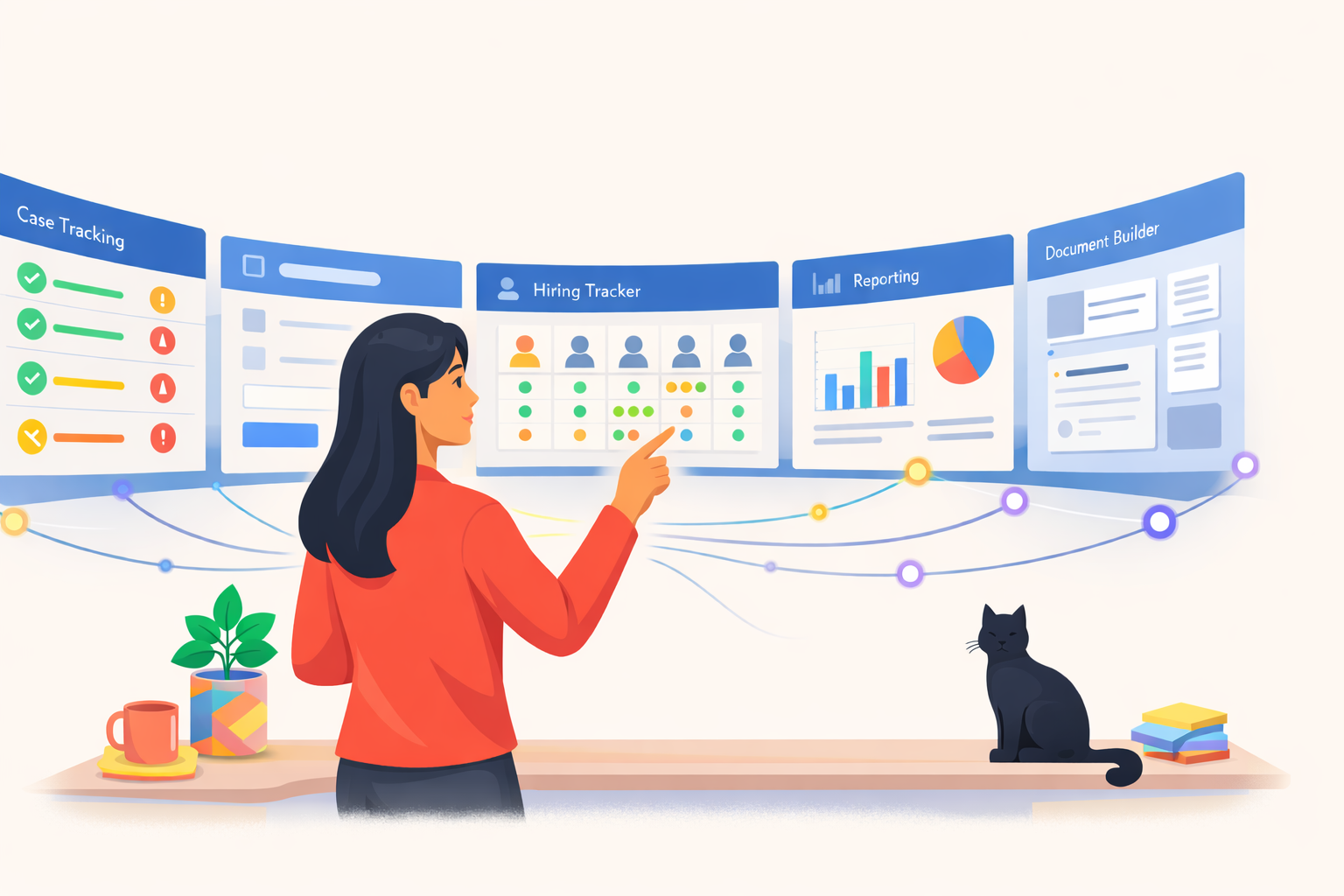
- A non-profit case manager builds a case tracking dashboard with status badges, priority flags, and full case histories, all in an afternoon.
- A small business owner creates client intake forms and a feedback survey that replace paper processes and clunky PDFs, without paying for a platform.
- An HR manager at a 30-person organization builds a staffing tracker with job descriptions, competency scoring, and hiring board evaluations, all tailored to how they actually hire, not how a vendor thinks they should.
- A team lead puts together a prompt library with templates for the emails, reports, and meeting agendas her team writes every week.
None of these required a developer. None required a procurement process. Each one was built by someone who knew exactly what the problem was and now had the ability to solve it.
You don't need an IT department
The old model was clear: if you wanted a custom tool, you needed technical people to build it for you. The new model is different. You need someone who understands the work, and that person is almost certainly already on your team.
The skills required to build these tools aren't programming skills. They're communication skills: the ability to clearly describe what you need, evaluate what you get back, and refine it until it works. Those are skills that any professional can learn, and they build on the domain knowledge that small organizations already have in abundance.
A case worker who has managed a caseload for ten years knows more about what a case tracking system needs than most software designers. A hiring manager who has run dozens of panels knows exactly what's missing from the spreadsheet they've been using. That knowledge was always the hard part. The building is now the easy part.
The advantage small organizations actually have
Here's something that rarely gets said: small organizations are actually better positioned to benefit from this shift than large ones.
Big organizations move slowly. They need procurement approvals, security reviews, change management plans, and executive buy-in before a new tool can be introduced. A simple dashboard can take six months to go from idea to implementation.
A small organization? The person who has the idea can build the tool, test it with their team, and start using it, all in the same week. There's no approval chain. There's no vendor negotiation. The feedback loop between "this is what we need" and "here it is" is as short as it can possibly be.
Small teams can move from problem to solution faster than any enterprise. That's not a limitation. It's a superpower.
Starting doesn't require a strategy document
One of the barriers that keeps small organizations on the sidelines is the belief that AI adoption needs to be a big, planned initiative. It doesn't. It can start with one person solving one problem.
Build the form you've been meaning to build. Create the tracker your team has been asking for. Put together the reporting dashboard that would save you a day every month. Start with the thing that frustrates you most, and work outward from there.
Each tool you build teaches you something. By the third one, you're not just solving individual problems. You're developing a capability that compounds. Your team starts to see what's possible. The mental list of "things we can't fix" gets shorter.
What coaching looks like for small teams
If your team is ready to start but isn't sure how, that's exactly where coaching fits in. Not a course you watch passively. Not a training day that gets forgotten by Friday. It's structured, hands-on learning built around your team's actual work.
We start with security: what's safe to share with AI tools and what isn't. Then we build real skills: how to prompt effectively, how to evaluate what you get back, how to iterate toward something you can actually use. And we do it using your real workflows, your real documents, and your real problems.
By the end, your team doesn't just know about AI. They know how to use it safely, practically, and in ways that make their work better every day.
The organizations that will benefit most from AI aren't the biggest. They're the ones where the people closest to the work are empowered to act on what they know.
If you've been waiting because you thought this wasn't for organizations like yours, it is. And the best time to start is before the gap between you and the organizations that have already started gets any wider.